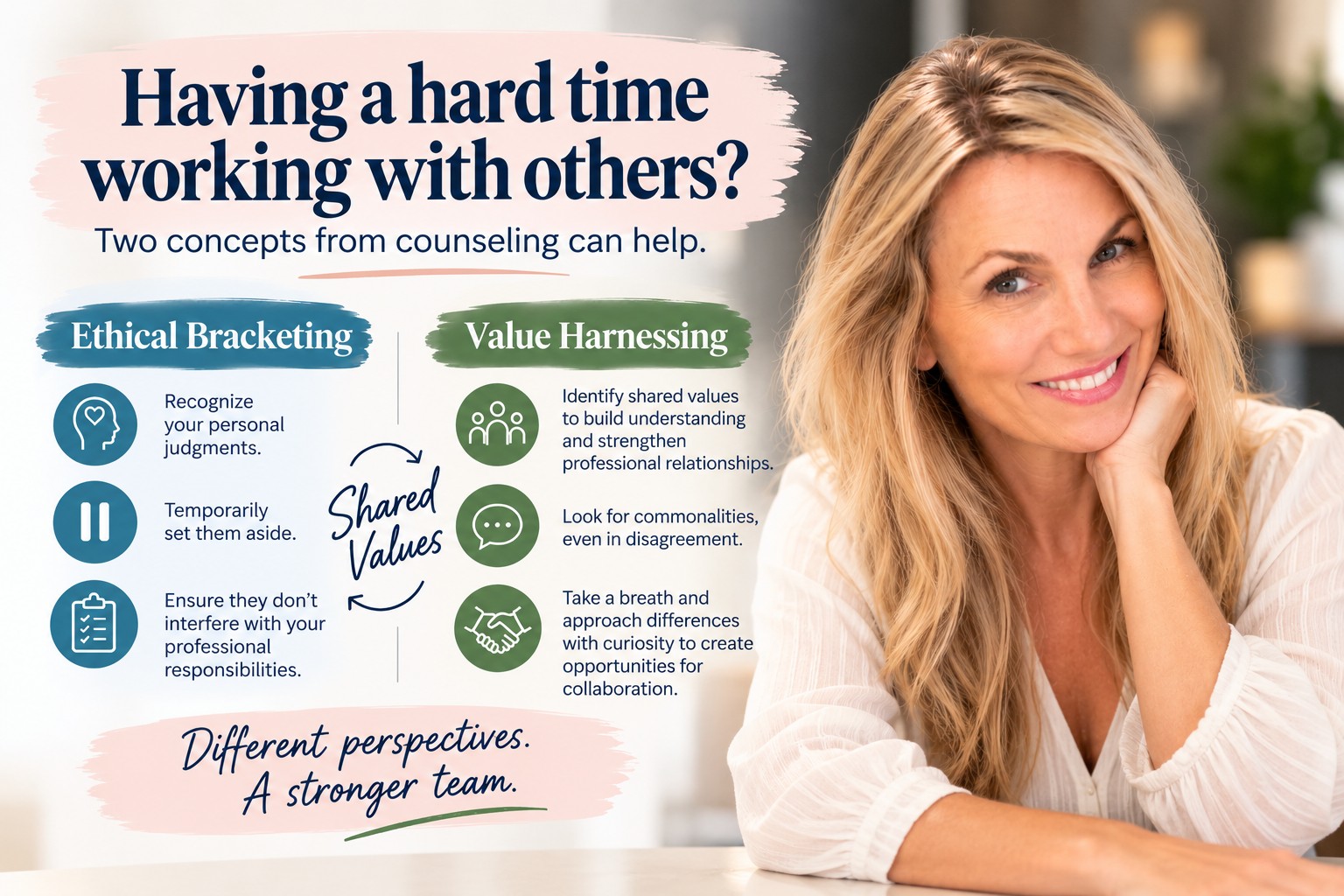
We spend considerable time talking about diversity and inclusion, but perhaps less time discussing what happens when our differences challenge our personal convictions. That's where two concepts I encountered in my graduate counseling coursework offer useful lessons for the workplace.
Ethical Bracketing
While studying counseling—I’m a forever student and will spend my money on graduate courses over designer clothes any day—I encountered the concept of ethical bracketing.
In counseling, ethical bracketing involves recognizing our personal judgments and temporarily setting them aside so they don't interfere with our professional responsibilities or our ability to serve others. It doesn't mean abandoning our values. Quite the opposite. It asks us to recognize our own values while ensuring they don't interfere with our professional responsibilities or become expectations we impose on others.
This distinction has an important place in organizational culture.
We can hold strong convictions without expecting everyone around us to share them. We can disagree with colleagues without diminishing their worth and recognize that understanding another person's perspective doesn't require surrendering our own. When we embrace these truths, we free ourselves from treating every disagreement as a threat. We can simply be.
Value Harnessing
Another concept I explored in my coursework was value harnessing, an approach that encourages counselors to identify shared values to build understanding and strengthen professional relationships.
For example, we can have a major professional disagreement about how to handle a difficult client. Our positions and paths of attack may appear incompatible. And we legitimately may be at a crossroads. However, instead of starting a brawl on the conference room table, we can take a breath and assess our commonalities: we both may value honesty, trust and the client's long-term interests.
Identifying those shared values creates an opportunity for collaboration rather than conflict. This doesn't mean every disagreement has a comfortable middle ground. Sometimes values genuinely conflict, and sometimes an organization's professional obligations will trump our 30-60-90 plan. All that said, approaching differences with curiosity rather than immediate judgment (aka fear in action) can help us navigate fundamental conflicts and disagreements about how to achieve a common goal.
What this means for communications teams
I've spent more than two decades working in communications, where understanding different audiences and perspectives is fundamental to the job.
Effective communication doesn't force us to agree with everyone we're trying to reach. It requires us to understand what matters to them, recognize where our perspectives intersect and communicate in ways that establish mutual respect instead of defensiveness.
The same principle applies to the relationships we build with our colleagues.
Research and references
- Kocet, M. M., & Herlihy, B. J. (2014). Addressing value-based conflicts within the counseling relationship: A decision-making model. Journal of Counseling & Development, 92(2), 180–186. https://doi.org/10.1002/j.1556-6676.2014.00146.x
- Mitchell, D. N. C., Martin, L. E., Ebersole, D. B., & Shaler, L. A. S. (2023). The HARNESS model for reconciling values in the counseling relationship. Counseling and Values, 68(2), 213–234. https://doi.org/10.1163/2161007x-bja10007
- Remley, T. P., Jr., & Herlihy, B. P. (2024). Ethical, Legal, and Professional Issues in Counseling (7th ed.).