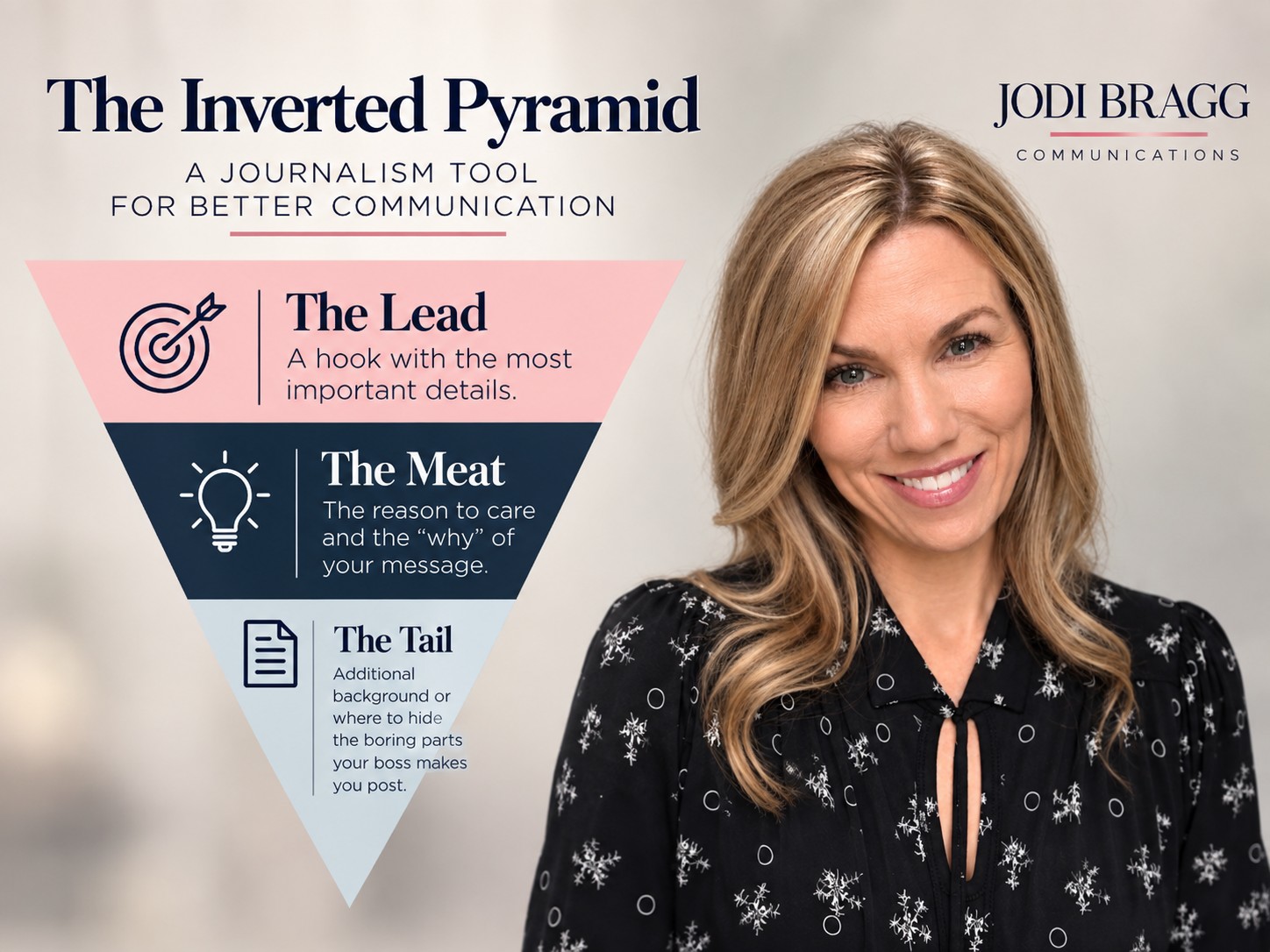
One of the first things I learned in journalism was that everything cannot be the lead.
A reporter may conduct hours of interviews, fill pages of notes and collect dozens of interesting details. But eventually, someone must answer a deceptively simple question: What matters most?
Journalists have a tool for doing that: the inverted pyramid. The most important information goes at the top. Supporting information follows. Details decrease in importance as the story continues.
It's an old journalism model, but I've come to believe it's an extraordinarily useful way to think about organizational communication.
The problem isn't always lack of information
Organizations rarely suffer from having nothing to say. More often, they have too much: a new initiative has six objectives; an executive wants to communicate four priorities; legal needs three caveats included; marketing has key messages; operations needs employees to understand the process; someone wants to mention the company's history… And everyone involved believes his or her piece is essential.
Put all of it into one communication and something predictable happens: The audience doesn't know what matters, and the message gets lost. That's not an information problem. It's a prioritization problem.
Find the lead before you find the words
Years after first learning the inverted pyramid as a journalism student, I found a new use for it while studying organizational coaching at the University of Georgia. When tasked with developing my own coaching model, I adapted the familiar journalism framework to help people sort through complicated narratives—competing goals, concerns, possibilities and pressures—and identify what deserved priority.
It occurred to me that good coaching and good communication share something important: Both require us to make sense of complexity before deciding what to do with it.
That's why one of the most useful questions a communicator can ask at the beginning of a project isn't: What do we want to say? It's: What does our audience most need to understand? Those questions sound similar. They aren't. The first can put the executives and egos first. The second puts the audience first.
The discipline of leaving things out
Prioritization can be uncomfortable because deciding what matters most also means deciding what matters less. Internal politics often play a major role in this decision, too. Someone needing to check a box can mandate a post or press release that no one is going to care about. In those cases, as in all cases, understanding the hierarchy of information–and finding a compelling way to earn the audience’s attention–is imperative.
- What's the one thing people need to know?
- How do we present it so it’s clear, concise and interesting?
- What context do they need to understand it?
- What information helps them act?
- What are we including primarily because our boss is making us, even though we know it’s not going to land?
I've watched communications become exponentially clearer when teams answer those questions before drafting begins. The inverted pyramid forces that discipline. It turns a pile of information into a hierarchy of meaning.
So what? Who cares? Why bother?
Those three questions have followed me throughout my communications career. They take the Who? What? When? Where? Why? and How? of the content and force us to think about its intended purpose.
- So what? What is actually significant here?
- Who cares? Who needs this information, and why does it matter to them?
- Why bother? What should be different because we communicated at all?
If we can’t answer these questions, it’s back to the drawing board. A supervisor saying, “because I said so!” may explain why something has to be communicated. But it doesn’t excuse communicating it badly.
Technology has dramatically changed how quickly we can create and distribute content. AI has accelerated that even further. But producing more words doesn't solve the problem of knowing which words matter.
Sometimes the most strategic thing a communicator can do is something journalists have been doing for generations:
Find the lead.